Causal Impact Analysis
causal-impact.Rmd📊 Causal Impact Analysis
Causal Impact is a Bayesian structural time-series method used to evaluate the effect of an intervention when randomization is not feasible.
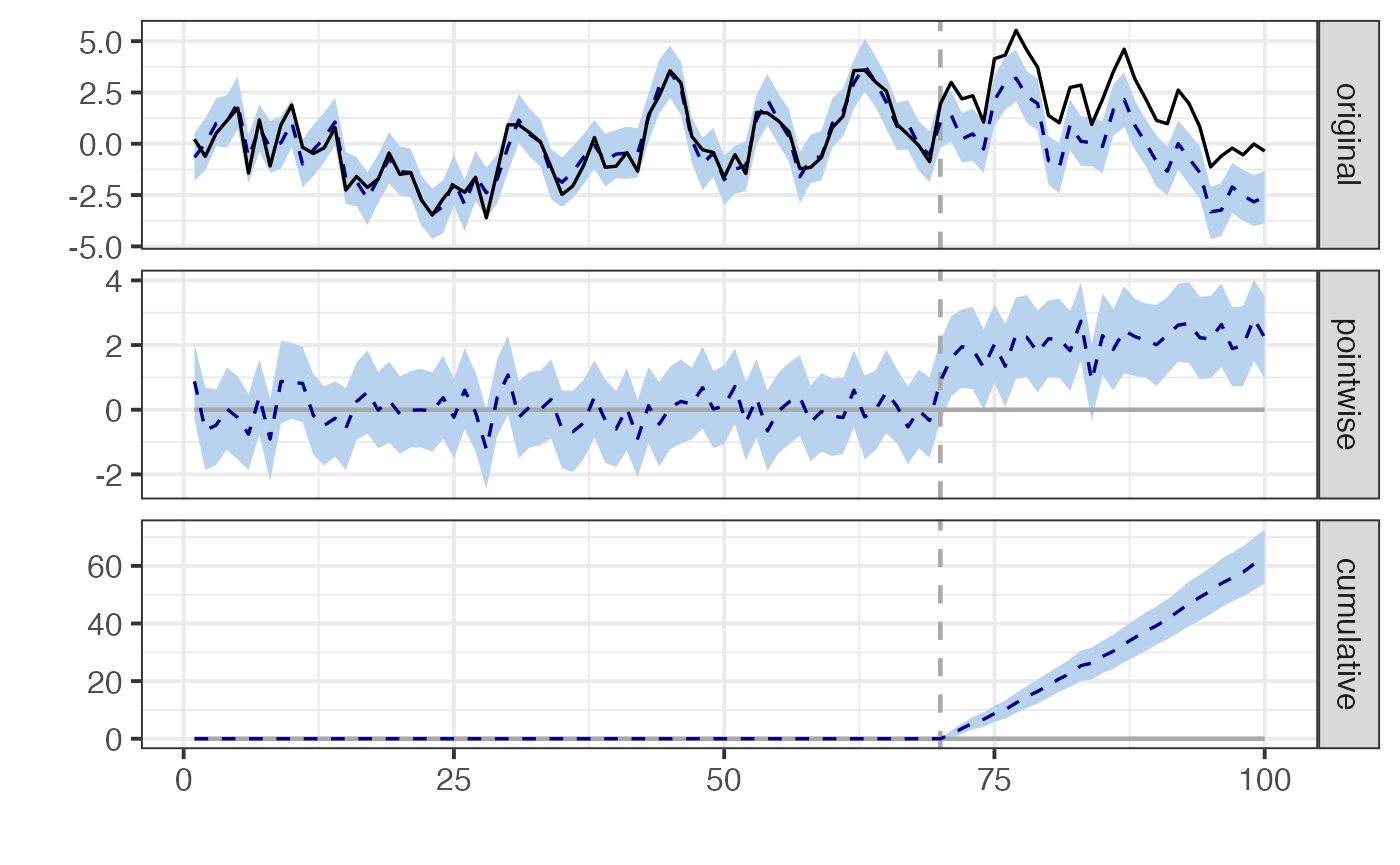
🧪 Simulate Pre/Post Intervention Time Series
set.seed(101)
n <- 100
pre_period <- 1:70
post_period <- 71:100

x <- arima.sim(model = list(order = c(1, 0, 0), ar = 0.8), n = n)
y <- x + rnorm(n, 0, 0.5)

# Add treatment effect in post period
y[post_period] <- y[post_period] + 2

data_ts <- cbind(y, x)
📈 Run Causal Impact
## Posterior inference {CausalImpact}
##
##                          Average             Cumulative
## Actual                   2                   60
## Prediction (s.d.)        -0.092 (0.16)       -2.771 (4.87)
## 95% CI                   [-0.41, 0.2]        [-12.43, 6.1]
##
## Absolute effect (s.d.)   2.1 (0.16)          62.9 (4.87)
## 95% CI                   [1.8, 2.4]          [53.9, 72.5]
##
## Relative effect (s.d.)   -625% (32539%)      -625% (32539%)
## 95% CI                   [-16020%, 13361%]   [-16020%, 13361%]
##
## Posterior tail-area probability p:   0.00101
## Posterior prob. of a causal effect:  99.8993%
##
## For more details, type: summary(impact, "report")
plot(impact)